
Sustainability
Copiso Soria
Farm to Fork Strategy
Environmental footprint
Reducing the environmental and climate footprint of the food system.
Global transition
Leading a global transition to competitive Farm to Fork sustainability.
New opportunities
Take advantage of new opportunities.
Resilience
Create a strong and resilient food system.
Renewable Energy
At Copiso we are committed to environmental sustainability and the decarbonization of industrial processes. Therefore, in our facilities we have biomass boilers and solar panels to generate part of the energy needed for production processes. In addition, we are committed to the use of geothermal or purithermal energy in our own farms or newly built integrated farms.
The cooperative’s largest energy consumption is in the feed mill, which is powered by a biomass boiler that was part of the Climate Projects of the Carbon Fund for a Sustainable Economy (FES-CO2).
The 1760Kwp solar photovoltaic plant was installed in September 2022 with a total investment of €955,252 and supplies the entire Copiso industrial complex in Valcorba. The roofs of the cereal warehouses, which cover an area of 13,717m2, were used for the installation of 3,325 540 W panels, and the placement of 17 100 KW inverters and one 60 KW inverter.
For the execution of this photovoltaic installation, a grant of 110,968.80 Euros has been received from the program of incentives linked to self-consumption and storage, with renewable energy sources. Its framework is the Recovery, Transformation and Resilience Plan, financed by the European Union-NextGenerationEU.

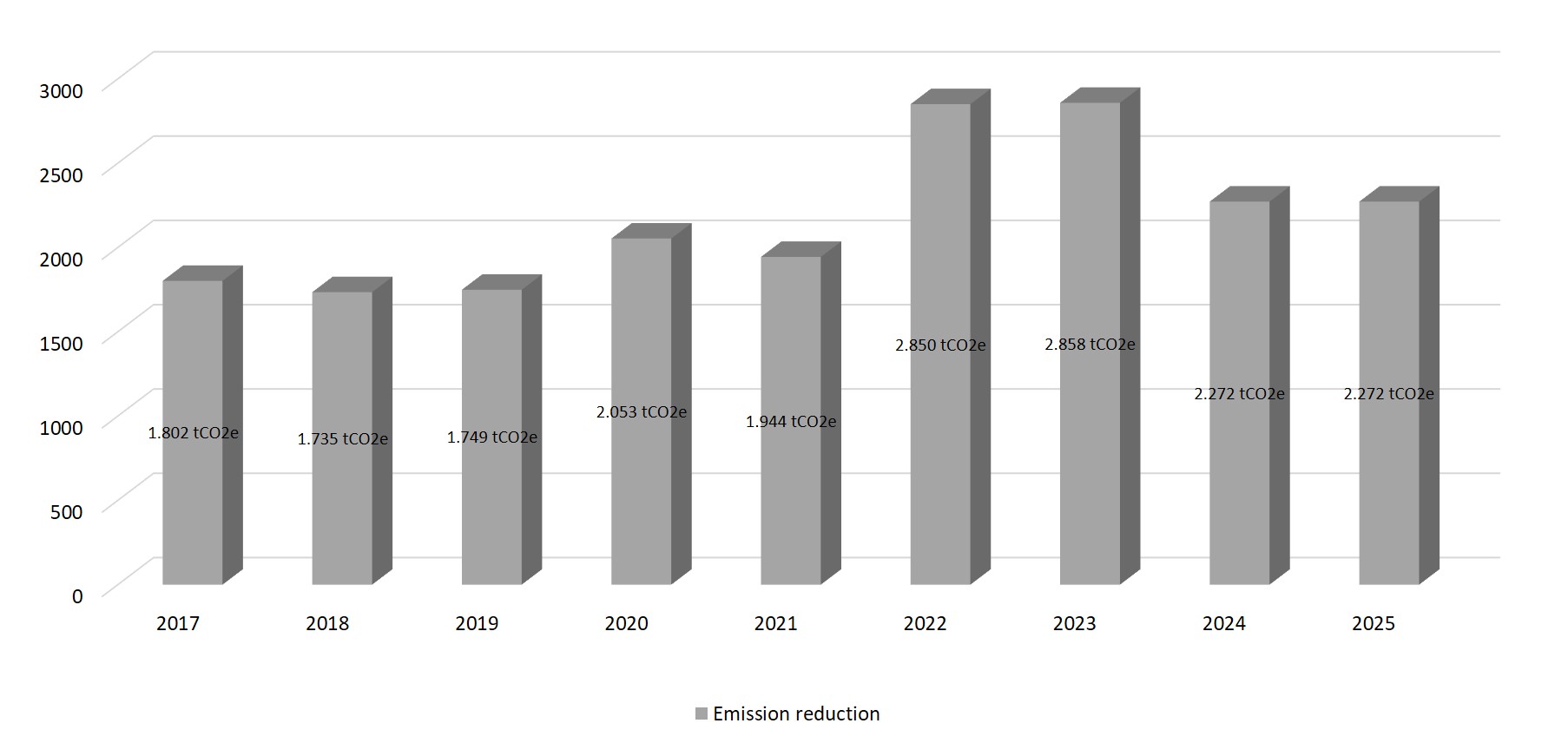
Emission Reduction
at our facilities in the Valcorba industrial complex
We are committed to the circular economy and environmental conservation
At Copiso we work under a philosophy of responsibility and commitment, respecting today’s resources to ensure the well-being of tomorrow’s generations, creating long-term sustainable value and improving the development of the rural environment.
CONTRIBUTION TO THE 2030 AGENDA
Sustainable Development Goals
At Copiso we are committed to sustainable development by contributing specifically to 14 of the 17 United Nations Sustainable Development Goals (SDGs).
- We drive circular economy through SDGs 7 and 13.
- We protect people's health and safety through SDG 3.
- We are committed to society and the environment with SDGs 9, 11, 16 and 17.
- We are committed to equal, secure and stable employment with SDGs 4, 5, 8 and 10.
- We promote responsible production and consumption through SDGs 2, 12 and 15.
ORGANIC FERTILIZATION
And its responsible use
Organic fertilization is the perfect ally for crops as it improves soil structure due to its organic matter content. It provides necessary nutrients for the good development of crops such as nitrogen, phosphorus and potassium.
The use of livestock manure as organic fertilizer is part of a circular economy model that maintains the usefulness of this resource by giving it a new value and reducing the consumption of raw materials and resources for the manufacture of other fertilizer products.